
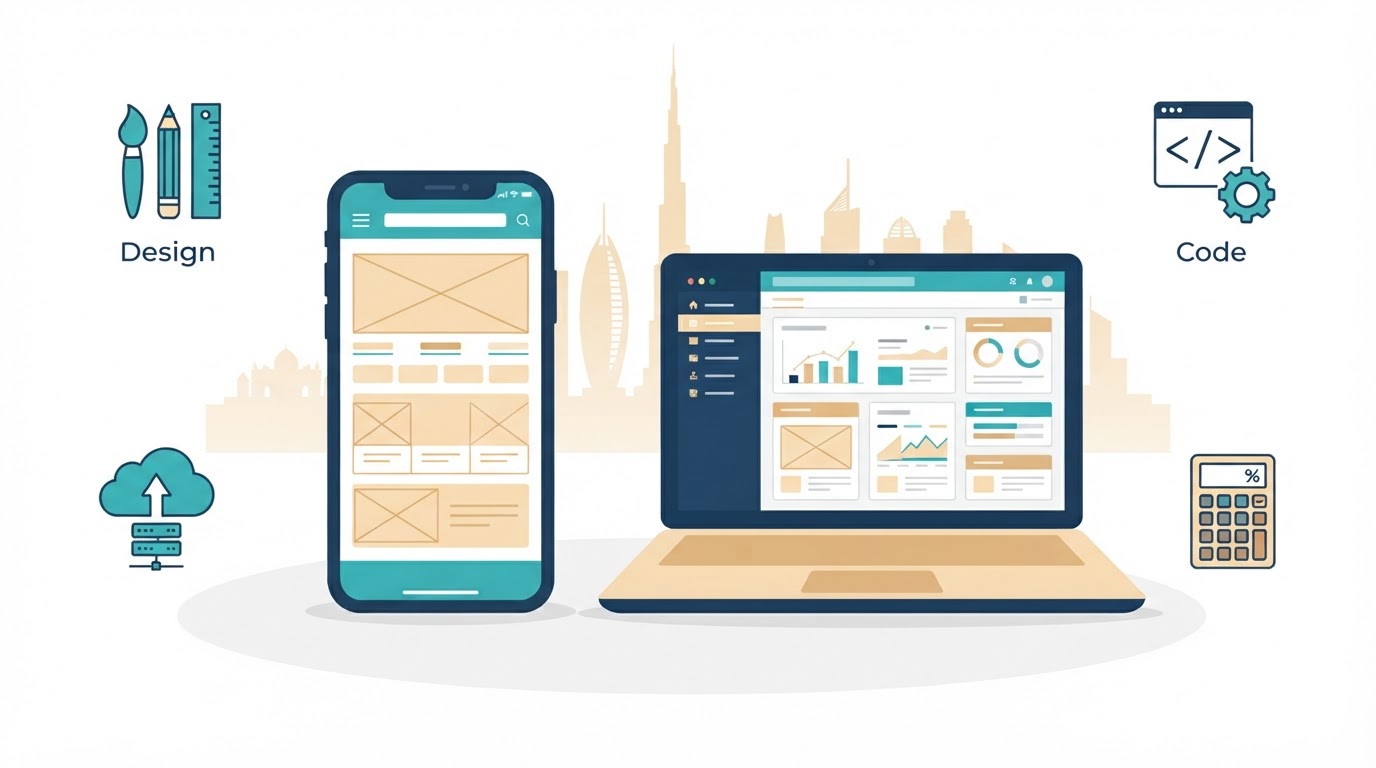
The cost of a custom app in the UAE is set mostly by scope: how many features it has, how many types of user it serves and how many other systems it has to talk to. After that come the platforms you build for, the depth of design, Arabic and English support, data protection rules and the upkeep after launch. Nobody can give you a fair price until the scope is written down, so the most reliable way to budget is to define a small first version and price that.
What actually decides the price of a custom app?
The price is mostly the number of hours a team spends designing, building, testing and launching the app, and scope decides those hours.
Every quote you receive is an estimate of time multiplied by a rate. Rates differ between teams and countries, but the hours differ far more. Two “simple booking apps” can be months apart in effort once you list what each one has to do. These are the things that move the number most:
- Features and user roles, such as a customer app, a staff app and an admin panel
- Integrations with payment gateways, CRMs, ERPs, delivery partners or government services
- Platforms: iPhone, Android, web, or all three
- How custom the design is
- Arabic and English, with right-to-left layouts
- Security and data protection requirements
- Testing, launch and support after go-live
How does scope change the cost?
Each feature adds design, build, testing and maintenance work, so scope is the biggest lever you have on your budget.
Features hide work. A login screen looks small. Behind it sit password resets, email or SMS verification, account deletion, perhaps sign-in with Apple or Google, and an admin view to help users who get locked out. Multiply that by every screen and you can see why vague briefs produce wildly different quotes.
Scope also grows once work starts. The Project Management Institute’s 2018 Pulse of the Profession survey found that 52 per cent of projects completed in the previous 12 months experienced scope creep, up from 43 per cent five years earlier. Most of that comes from good ideas arriving mid-build. The fix is dull but it works: split your list into “needed at launch” and “later”, and agree in writing how changes get priced before anyone writes code.
If you are still unsure whether your idea needs an app at all, read our guide on when to build a custom app first.
Does building for iPhone and Android double the cost?
Not necessarily: a cross-platform framework lets one codebase serve both, while separate native apps for each platform cost more to build and maintain.
Frameworks such as Flutter and React Native cover most business apps well. Native builds still make sense when an app leans heavily on the camera, Bluetooth, background location or other device features. And sometimes the cheapest mobile app is a well-built web app that works in the phone’s browser, with no store review and no store fees.
If you do publish to the stores, there are platform costs to plan for. Google Play charges a US$25 one-time registration fee. Apple’s Developer Program, which you need to publish on the App Store, is a paid membership. If your app sells digital goods or subscriptions, Apple also takes a commission. Under its App Store Small Business Program, the rate is 15 per cent for developers with no more than US$1 million in proceeds a year. Check this early if your revenue model depends on in-app sales.
How much do design and Arabic support add?
Design and bilingual support add real hours, because every screen has to work in English from left to right and in Arabic from right to left.
Arabic support is more than translation. Layouts mirror, some icons flip, text lengths change and dates and numbers may need different formats. Each screen then has to be tested in both directions. Planning for this from the first wireframe is far cheaper than retrofitting it after launch, when every screen has to be reopened.
Design depth matters too. A clean, consistent interface built from a small set of reusable components costs less than a fully bespoke look with custom animations on every screen. Good design is still worth paying for, since it decides whether people keep using the app. We cover this in how UI/UX design affects product growth.
What do UAE rules and integrations add to the budget?
Handling personal data, taking payments and connecting to other systems all add work, and a good quote names each one.
The UAE’s Federal Decree-Law No. 45 of 2021 on the Protection of Personal Data has been in force since 2 January 2022. It covers the processing of personal data, consent and transfers of data outside the country. Some free zones have their own rules; the DIFC, for example, has its own Data Protection Law (DIFC Law No. 5 of 2020). Where your business is licensed and where your data is stored can change what the app must do, such as consent screens, data export, deletion requests and access logs. We are not lawyers, so confirm your obligations with a legal adviser before the build starts.
Tax affects the budget as well. VAT was introduced in the UAE on 1 January 2018 at 5 per cent, so ask whether each quote includes it.
Integrations are often where estimates go wrong. Each payment gateway, accounting tool or delivery partner needs accounts, sandbox testing, error handling and sometimes its own monthly or per-transaction fees. Ask your developer to list every integration and who pays for it.
What costs continue after launch?
Hosting, monitoring, security patches, updates for new iOS and Android versions and user support all continue after launch, so budget for them from day one.
An app is never finished. Apple and Google release new operating system versions every year, libraries need security updates and cloud hosting bills grow with your users. Ask for a maintenance quote alongside the build quote, so you are comparing the full cost of owning the app and not just the cost of launching it.
What pushes the cost up, and what keeps it down?
Most cost drivers have a cheaper and a dearer version, and you can choose which one you need for launch.
| Cost driver | Pushes cost up | Keeps cost down |
|---|---|---|
| Scope | Every idea in version one | A short must-have list, the rest later |
| Platforms | Separate native iOS and Android apps | Cross-platform, or a web app first |
| Design | Bespoke visuals and animation on every screen | A small, reusable component set |
| Languages | Arabic added after launch | Arabic and English planned from the first wireframe |
| Integrations | Many third-party systems at once | The one or two that matter most |
| Changes | No agreed change process | Written change control before the build |
How should a business owner budget for a custom app?
Budget in stages: pay for scoping first, then build a small first version, then grow it based on what users actually do.
- Write down the problem, who has it and how you will measure whether the app solved it.
- Check whether an existing product already does the job. Our comparison of custom apps and off-the-shelf software can help.
- Run a scoping or discovery phase that ends in a written feature list, user flows and an estimate.
- Split features into “needed at launch” and “later”, and price the first group.
- Ask for quotes that list assumptions, exclusions, VAT, store fees, hosting and maintenance separately.
- Keep a contingency for changes and agree how they will be approved and priced.
Why do quotes for the same app vary so much?
Quotes vary because each company assumes a different scope, team, quality bar and level of support after launch.
A low quote often leaves out testing, admin panels, Arabic support or maintenance, and those costs come back later. A high quote may include things you do not need yet. Give every company the same written brief and compare what each one includes, line by line. Where the team sits also affects the rate, so ask each company who will do the work, where they are based and who you will speak to day to day.
Frequently asked questions
Can I get a price for an app without a specification?
You can get a rough range, but it will be a guess. A short scoping session that produces a feature list gives you a number you can actually plan around.
Is a web app cheaper than a mobile app?
Often, yes. One codebase runs on every device and there is no app store review or store fee. If your app needs heavy use of the phone’s hardware, a mobile app may still be the better choice.
Should my app budget include VAT?
Yes. VAT in the UAE is 5 per cent, so check whether each quote is shown before or after VAT so you compare them fairly.
Will I own the code once the app is built?
You should. Make sure the contract transfers ownership of the code and design to your company and gives you access to the source code repository. Ask a legal adviser to review the wording.
Get a clear estimate for your app
Hashigo Technologies designs and builds custom web and mobile apps for business owners and SMEs from our offices in IFZA, Dubai Silicon Oasis, in Chennai and in London. We will help you define a first version you can afford and give you an estimate that spells out what is included. See our services, or book a free consultation to talk through your app idea.
One comment on “What Drives the Cost of Building a Custom App in the UAE?”
Comments are closed.